
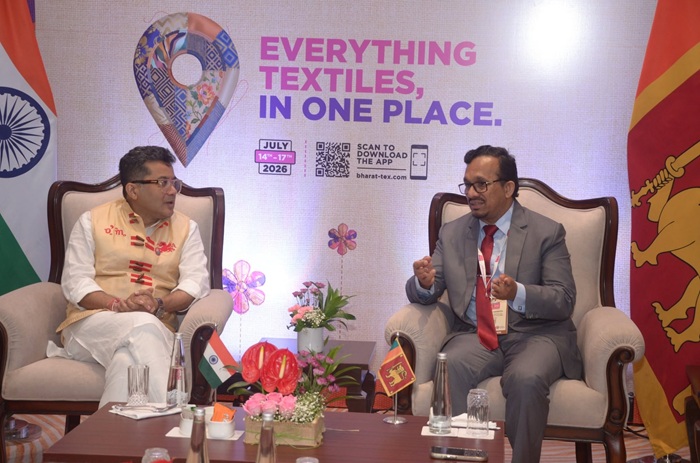
In a significant move poised to redefine the industrial landscape of South Asia, Sri Lanka and India have formalised a comprehensive partnership aimed at modernising the Sri Lankan textile sector. This announcement, made on July 15, 2026, follows high-level bilateral discussions held during the Barath Tex international exhibition in New Delhi. The collaboration is designed to enhance the global competitiveness of Sri Lankan textiles by integrating cutting-edge Indian technology, investment, and educational expertise.
The discussions were spearheaded by Sri Lanka’s Minister of Industry and Entrepreneurship Development, Sunil Handunneththi, and India’s Union Minister of Textiles, Giriraj Singh. The meeting was also attended by India’s Minister of State for Textiles, Pabitra Margherita, and Sri Lanka’s High Commissioner to India, Mahishini Colonne, alongside several senior government officials. This high-profile engagement underscores the depth of the commitment between the two nations to foster a more resilient and technologically advanced industrial base.
A Vision for Industrial Modernisation
The partnership is rooted in a shared vision to elevate Sri Lanka’s textile industry from its traditional foundations to a high-tech, export-oriented powerhouse. Minister Sunil Handunneththi emphasised that India has pledged its full support to facilitate this transition, offering both technical guidance and substantial investment. This support is instrumental as Sri Lanka seeks to navigate the complexities of the modern global market, where efficiency and innovation are the primary drivers of success.

For decades, the textile sector has been a cornerstone of the Sri Lankan economy, yet it has often faced challenges related to aging infrastructure and a reliance on traditional methods. By leveraging India’s established prowess in textile engineering and manufacturing, Sri Lanka aims to bypass several stages of incremental development. The focus is not merely on increasing output but on ensuring that the quality and variety of Sri Lankan textiles can meet the sophisticated demands of international buyers in Europe, North America, and across the Global Sri Lankan community.
Empowering Youth through Educational Excellence
One of the most transformative elements of this agreement is the focus on human capital. It was announced that Sri Lankan youth will be provided with degree-level training opportunities through India’s prestigious National Institute of Fashion Technology (NIFT). This initiative is designed to equip the next generation of Sri Lankan designers, engineers, and managers with the skills necessary to lead a modernised industry.
Capacity building is seen as the bedrock of sustainable industrial growth. By providing access to NIFT’s world-class curriculum, the partnership ensures that the modernisation process is supported by a workforce that is well-versed in global trends, sustainable practices, and advanced manufacturing techniques. This educational exchange is expected to foster a new era of entrepreneurship within the Sri Lankan community, as graduates return with the expertise to establish innovative startups and lead established firms into new markets.
Blending Tradition with Technological Innovation
A unique aspect of the partnership is the emphasis on integrating traditional handloom production with modern textile technologies. Sri Lanka possesses a rich heritage of handloom weaving, an art form that is replete with cultural significance and artisanal value. However, the manual nature of this production often limits its scalability and consistency.

The joint projects proposed by Minister Handunneththi and Minister Giriraj Singh aim to bridge this gap. By introducing modern technological interventions into the handloom process, the partnership seeks to preserve the authentic aesthetic of traditional Sri Lankan fabrics while enhancing their durability and production efficiency. This fusion of the old and the new is intended to create a unique niche for Sri Lankan products in the global “slow fashion” and artisanal markets, where authenticity and high-quality craftsmanship are increasingly valued.
Strategic Investments in Mineral Resources
Beyond the direct scope of textiles, the bilateral talks also extended to the strategic sector of mineral resources. Minister Handunneththi revealed that India has expressed a strong interest in providing investment support for the development and extraction of Sri Lanka’s industrial minerals. This is a critical component of the broader industrialisation strategy, as minerals such as graphite, ilmenite, and silica are essential inputs for various high-tech manufacturing processes, including the production of specialised industrial textiles.
The infusion of Indian investment into the mineral sector is expected to drive Sri Lanka’s industrialisation to new heights. By developing a domestic supply chain for essential raw materials, Sri Lanka can reduce its reliance on imports and improve the overall cost-effectiveness of its manufacturing sector. This holistic approach ensures that the modernisation of the textile industry is part of a wider, more integrated industrial ecosystem.
Strengthening Ties with Sri Lankans Abroad
The implications of this partnership extend far beyond the shores of the island nation. For Sri Lankans living in Australia, Canada, the UK, and elsewhere, the revitalisation of the home country’s industrial sector is a source of immense pride and potential opportunity. As the industry modernises, there will be increased avenues for collaborative ventures, trade, and the promotion of high-end Sri Lankan textile brands globally.
eLanka remains committed to highlighting these positive developments that connect our global community with the progress taking place in Sri Lanka. The strengthening of ties between Sri Lanka and India is a testament to the collaborative spirit that is necessary for regional stability and economic prosperity. As these projects come to fruition, they will undoubtedly create a more vibrant and competitive industrial environment that benefits Sri Lankans everywhere.
In conclusion, the agreement reached between Minister Sunil Handunneththi and Minister Giriraj Singh marks a pivotal moment in Sri Lanka’s economic history. Through a combination of technical support, educational exchange, and strategic investment, the textile industry is being positioned for a future defined by innovation and excellence. The commitment shown by India to support its neighbour’s industrial aspirations reflect a deep and enduring partnership that promises to yield significant dividends for years to come.
Source: https://www.newswire.lk/2026/07/15/sri-lanka-india-eye-major-textile-industry-partnership/
This article was written based on the source https://www.newswire.lk/2026/07/15/sri-lanka-india-eye-major-textile-industry-partnership/, kindly email us at info@eLanka.com.au if any information needs to be corrected.
At eLanka, we respect the rights of creators. If we have used an image you own and you’d like it removed, please email us at info@elanka.com.au and we’ll handle it promptly.


