
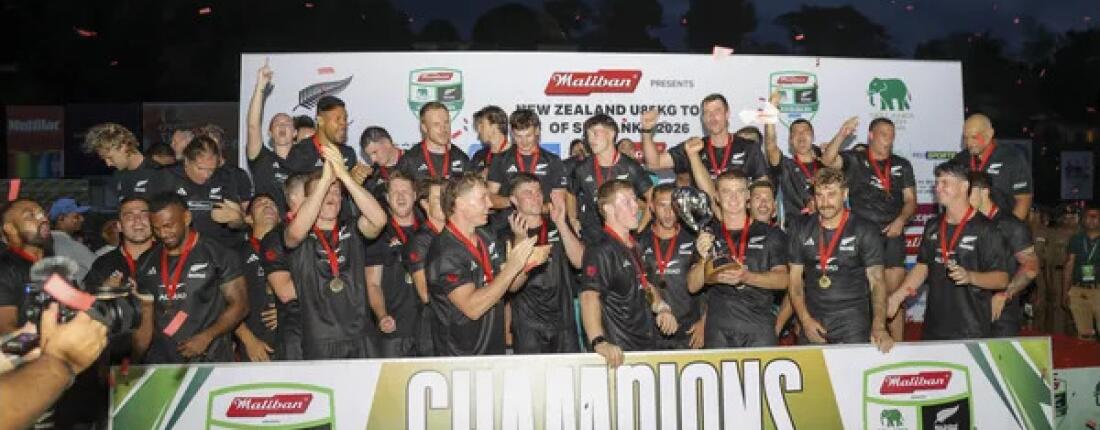
The historic Nittawela Stadium in Kandy, a venue traditionally steeped in the rich heritage of Sri Lankan rugby, became the epicentre of an extraordinary display of sporting resilience and physical prowess on Sunday, 3rd of May 2026.
In an encounter that was as physically demanding as it was emotionally charged, the Sri Lankan national side, affectionately known as the “Tuskers,” faced off against the New Zealand Under 85kg side in a match that served as the second leg of the prestigious Sir Graham Henry Trophy. Whilst the final scoreline of 25–10 in favour of the visitors might suggest a comfortable victory for the New Zealanders, it provides only a partial narrative of a contest defined by Sri Lankan grit, a capacity crowd’s fervour, and a disciplinary crisis that saw the New Zealanders reduced to thirteen men during the height of the second-half struggle.
The Atmospheric Intensity of Nittawela
Nittawela Stadium, often regarded as the spiritual home of rugby in the hill capital, was replete with an electric energy long before the opening whistle was sounded. The capacity crowd, composed of thousands of passionate supporters, created a wall of sound that was instrumental in buoying the home side during the initial stages of the match. The Significance of this encounter cannot be overstated, as it represented a pivotal moment for the Sri Lankan Rugby community, providing an opportunity to measure their progress against a New Zealand side renowned for its tactical discipline and technical proficiency. The “Tuskers” entered the field not merely as participants, but as formidable contenders, driven by the memory of the previous year’s series and a collective desire to demonstrate their evolving physicality on the international stage.

A Stunning Early Lead and the Eruption of Joy
The commencement of the match was the antithesis of the tentative opening many analysts had predicted. Sri Lanka, capitalising on the initial surge of adrenaline provided by the home supporters, applied immediate and relentless pressure on the New Zealand defensive line. This proactive approach was rewarded early in the first half when a lineout drive, executed with clinical precision, was brought down illegally near the New Zealand goal line. Referee Morgan White of Hong Kong, maintaining a firm hand on the proceedings, had no alternative but to award a penalty try to the home side.
This moment of triumph sparked a literal eruption of joy within the stadium, as the Tuskers took a stunning 7–0 lead. The psychological impact of this early advantage was profound, particularly as it was accompanied by the first of five yellow cards issued to the New Zealanders, with debutant Oli Dunn-Parrant being sent to the sin bin. For a period, the possibility of a historic upset felt tangible, as the Sri Lankan forwards, led by their senior players, dominated the physical exchanges and challenged the visitors’ composure.
New Zealand’s Tactical Resilience Amidst Disciplinary Struggles
Despite the early setback and the numerical disadvantage, the New Zealand Under 85kg side demonstrated the tactical maturity that is characteristic of their rugby culture. Coach Ben Sinnamon had emphasised the necessity of phase play and ball retention, and his players adhered to this mandate with admirable focus. A sustained period of offensive phases eventually culminated in lock Jack Laity barging over the line to level the scores at 7–7.
As the first half transitioned into a methodical grind, the individual brilliance of Jarred Percival became evident. Percival, who had been instrumental in orchestrating the New Zealand attack, successfully converted two penalties to grant his side a 13–7 lead as the halftime whistle blew. It was observed by spectators and commentators alike that the absolute scrum dominance enjoyed by the Sri Lankans in the previous week’s encounter in Colombo was no longer as decisive a factor, as the New Zealand front row, anchored by prop Tom Rowland, had made the necessary adjustments to neutralise the home side’s set-piece pressure.

Physicality and the War of Attrition
The second half commenced with the same relentless intensity that had defined the first forty minutes. Tom Rowland was well rewarded for an outstanding all-round performance when he drove over for a try following a lineout drive shortly after the restart, extending the New Zealand lead to 18–7. However, rather than the match opening up into a free-flowing spectacle, it devolved into a war of attrition, characterised by a series of disciplinary infractions that tested the resolve of both teams.
A simultaneous issuance of yellow cards to Jarred Percival and Sri Lanka’s Lahiru Thilakaratne, following a ruck infringement and subsequent retaliation, altered the tactical landscape of the match. With Percival sidelined, Pieter Swarts was required to transition into the first-five position for New Zealand. During this period, Thenunka Nanayakara, displaying remarkable composure under pressure, successfully knocked over a penalty to cut the New Zealand lead to eight points. The momentum appeared to be shifting back toward the Tuskers, as they utilised their superior physicality to harass the short-handed visitors.
Moments of Individual Brilliance and Defensive Bravery
The defining moment of the match, however, belonged to Francis Morrison. Having only joined the New Zealand squad on the Monday prior to the game, Morrison produced a try of such exceptional quality that it will likely be remembered for years to come. Receiving a wide cut-out pass from Swarts, Morrison embarked on a sidestepping spree that saw him beat nine Sri Lankan defenders before diving over next to the posts. This piece of individual magic provided the New Zealanders with a comfortable 25–10 lead, effectively securing the retention of the Sir Graham Henry Trophy.
Yet, the drama was far from over. Additional yellow cards issued to Frazer Harrison and Chad Crenfeldt-Smith, the latter for a deliberate knock-on and subsequently a high tackle, meant that New Zealand was forced to defend their lead with only thirteen men for a critical period of the final quarter. The Sri Lankans, sensed the opportunity and camped themselves on the New Zealand goal line, launching wave after wave of attack. It was here that the New Zealand defensive effort was most courageous; loose forwards Josh Gellert and Josh Evans were absolutely outstanding in their work rate, ensuring that the Tuskers could not find the final pass or drive needed to breach the line.
Conclusion: A Proud Chapter for Sri Lankan Rugby
As the final whistle resonated across the hills of Kandy, the New Zealanders celebrated with exhausted jubilation, having successfully navigated a disciplinary minefield to emerge victorious. For the Tuskers, while the result was a loss, the performance was a comprehensive testament to their growth. They had pushed one of the world’s most disciplined sides to the absolute limit, forcing them into uncharacteristic errors and demonstrating a level of physicality that was the antithesis of their performance in previous years.
The Sir Graham Henry Trophy remains in New Zealand’s possession for the second year in a row, but the 2026 series has proven that Sri Lankan rugby is on an upward trajectory. The grit shown at Nittawela Stadium serves as an inspiring chapter for the global Sri Lankan community, reminding us all of the untapped potential within our national athletes. At eLanka, we continue to celebrate these positive stories of resilience and excellence, connecting the diaspora with the proud sporting heritage of our motherland.
Source: https://www.allblacks.com/news/new-zealand-under-85s-survive-five-yellow-cards-to-defeat-sri-lanka
This article was written based on the source https://www.allblacks.com/news/new-zealand-under-85s-survive-five-yellow-cards-to-defeat-sri-lanka, kindly email us at info@eLanka.com.au if any information needs to be corrected.
At eLanka, we respect the rights of creators. If we have used an image you own and you’d like it removed, please email us at info@elanka.com.au and we’ll handle it promptly.


