
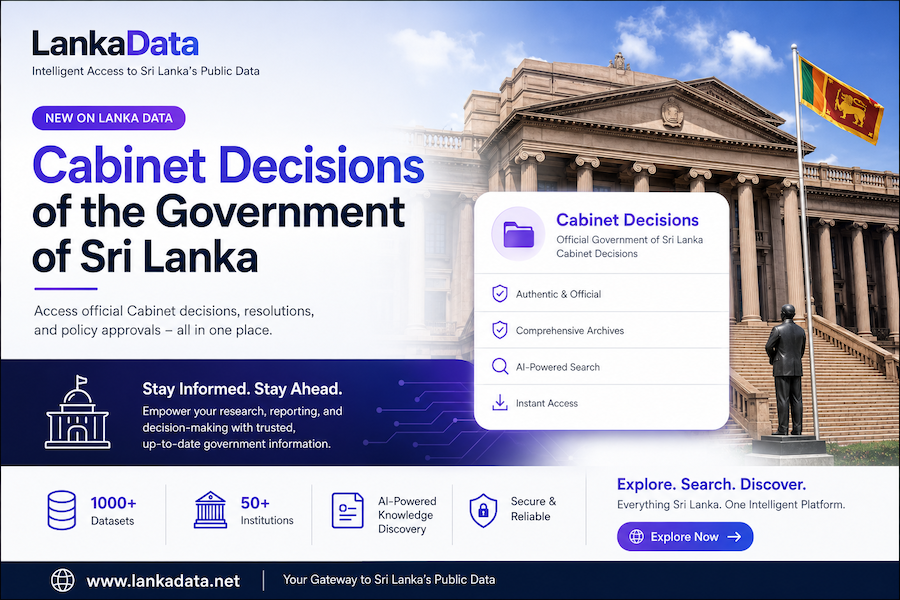
The landscape of public information in Sri Lanka has undergone a profound transformation with the latest expansion of LankaData, a premier open-data platform dedicated to enhancing transparency and accessibility. It was recently announced that official Cabinet Decisions of the Government of Sri Lanka have been integrated into LankaData’s comprehensive public information ecosystem. This development marks a pivotal milestone in the country’s journey toward digital governance, providing the Global Sri Lankan community and residents alike with an unprecedented level of access to executive decision-making processes.
By unifying cabinet approvals, policy frameworks, and development project details into a single, AI-powered interface, LankaData is addressing a long-standing challenge in the Sri Lankan administrative sphere: the fragmentation of official records. Previously, these vital documents were often scattered across various departmental portals or released as isolated PDF files, making comprehensive research a daunting task for journalists, legal professionals, and academics.
A New Era of Transparency and Accessibility
The integration of Cabinet Decisions into the LankaData Hub represents more than just a technological upgrade; it is a fundamental shift in how public records are managed and perceived. Cabinet memoranda often contain the blueprint for national growth, including details on large-scale infrastructure investments, regulatory reforms, and social welfare programmes. Ensuring that these records are not only available but also easily searchable is instrumental in fostering a culture of accountability.
For Sri Lankans abroad, staying informed about the policy shifts in their home country has often been hindered by the difficulty of accessing authoritative sources. This platform bridges that gap, allowing the global community to monitor development initiatives and legislative changes with the same ease as those residing within the island. The move is viewed as a significant step toward achieving the transparency goals that have been increasingly championed by civic society and international observers.
The Technological Architecture of LankaData
At the heart of this expansion is the Lanka Data Net (LDN) infrastructure, a sophisticated framework designed to handle vast amounts of structured and unstructured data. LankaData distinguishes itself from traditional document repositories by utilizing Retrieval-Augmented Generation (RAG) technology. This advanced AI model, integrated with the Chat2Find large language system, allows users to interact with the data in a more intuitive, natural-language format.
Unlike conventional keyword-based search engines that often yield irrelevant results, the RAG-powered system understands the context of a query. For instance, a user inquiring about “renewable energy policies” will be presented not just with documents containing those words, but with a contextual summary drawn from relevant cabinet decisions, legislative acts, and government circulars. This capability is particularly beneficial for professionals who require precise information quickly, such as those looking to start a successful business and needing to understand the current regulatory landscape.
Multilingual Support for an Inclusive Society
Recognizing the linguistic diversity of the Sri Lankan people, the platform has been built to be inherently multilingual. The AI assistant and search functions are fully functional in Sinhala, Tamil, and English. This inclusivity ensures that all citizens, regardless of their primary language, can engage with the government’s executive decisions and legal records.
The ability to retrieve complex legal and administrative information in one’s native tongue is a significant leap forward for social equity. It empowers individuals at the grassroots level to understand the policies that affect their daily lives, thereby democratizing access to information that was once the exclusive domain of those with specialized legal or administrative training.

A Comprehensive Repository of Public Knowledge
While the addition of Cabinet Decisions is the latest highlight, LankaData’s repository is already replete with a staggering volume of public information. The platform currently indexes over one billion structured datasets and more than 90,000 public documents. The scope of the information available is vast, encompassing several critical sectors:
- Legal Archives: Users can access a wealth of judicial history, including Supreme Court and Court of Appeal judgments, the Sri Lanka Law Reports, and New Law Reports.
- Legislative Documents: The platform includes consolidated Acts, amendments, and Parliamentary Bills, providing a clear view of the country’s evolving legal framework.
- Government Records: Ordinary and Extraordinary Gazettes, which serve as the official record of government actions, are fully searchable.
- Administrative Circulars: Essential for understanding public sector operations, these circulars provide guidance on institutional procedures and reforms.
- Economic Data: Extensive datasets regarding economic indicators and statistical information are available for researchers and policy analysts.
This centralized approach reduces the time and effort required for cross-referencing information. For example, a researcher can now simultaneously examine a Cabinet decision, the corresponding Parliamentary Bill, and any subsequent Supreme Court challenges within the same ecosystem. This level of integration is essential for a country that has seen calls for urgent system changes to improve governance and efficiency.
Empowering the Global Sri Lankan Community
The benefits of such an open-data platform extend far beyond the shores of the island. Sri Lankan expatriates living in Australia, the United Kingdom, Canada, and elsewhere often maintain deep personal and professional ties to their heritage. Access to authoritative government data allows them to engage more effectively in investment opportunities, charitable projects, and intellectual exchange.
Professionals within the global community, such as lawyers, consultants, and engineers, can utilize LankaData to maintain their expertise on Sri Lankan affairs. By providing a reliable source of truth, the platform helps to counter the spread of misinformation and ensures that the narrative regarding Sri Lanka’s development is based on factual, verifiable data.
Conclusion: A Foundation for Future Growth
The expansion of LankaData to include official Cabinet Decisions is a testament to the untapped potential of digital technology in enhancing public service. By prioritizing factual clarity and utilizing cutting-edge AI, the platform has established itself as an indispensable tool for anyone seeking to navigate the complexities of Sri Lankan governance and law.
As LankaData continues to incorporate additional datasets and refine its AI capabilities, it will undoubtedly remain at the forefront of the country’s open-data movement. For a nation looking toward a future of transparency and innovation, such initiatives provide the necessary infrastructure to build a more informed and engaged society.
This article was written based on the source https://www.independent.lk/lankadata-expands-sri-lankas-open-data-platform-with-official-cabinet-decisions/, kindly email us at info@eLanka.com.au if any information needs to be corrected.
At eLanka, we respect the rights of creators. If we have used an image you own and you’d like it removed, please email us at info@elanka.com.au and we’ll handle it promptly.


