
https://www.youtube.com/embed/VsBUOK964c0
The inauguration of the Indonesia Cultural Centre in Colombo has created a new and welcoming platform for cultural exchange, artistic collaboration and people-to-people friendship between Indonesia and Sri Lanka.
The centre was officially inaugurated on Wednesday, 12 August 2026, by Dewi Gustina Tobing, Ambassador of Indonesia to Sri Lanka and the Maldives, with Prof. Hiniduma Sunil Senevi, Minister of Buddhasasana, Religious and Cultural Affairs, attending as Chief Guest. The ceremony brought together representatives of diplomatic missions, government officials, school teachers, university lecturers, students, artists and cultural practitioners, reflecting the broad significance attached to the new institution.
Rather than functioning solely as a formal exhibition space, the Indonesia Cultural Centre has been established as an active meeting point where Indonesian traditions can be experienced, studied and shared. Its opening therefore represents more than the establishment of a new diplomatic facility; it marks a practical investment in cultural diplomacy and in the enduring relationship between two island nations with rich and diverse artistic traditions.
A cultural bridge between two friendly nations
Cultural diplomacy has increasingly become an instrumental element of international relations, particularly at a time when communities and institutions are seeking more meaningful ways to understand one another. Through music, dance, language, literature, film and education, cultural centres can create informal channels of communication that complement official diplomatic engagement.
The Indonesia Cultural Centre has been conceived in this spirit. Ambassador Dewi Gustina Tobing described the centre as a home for Indonesian culture in Sri Lanka, while also emphasising that it should not become a one-way showcase. Its wider purpose is to serve as a two-way bridge, enabling Sri Lankan artists to meet Indonesian artists, and allowing students, academics and cultural practitioners from both countries to exchange ideas.
That approach gives the centre considerable potential. A cultural institution becomes most valuable when it is not merely visited but used; when instruments are played, languages are learnt, films are discussed, exhibitions are interpreted and artistic traditions are allowed to evolve through contact with new audiences.
A space for learning and cultural discovery
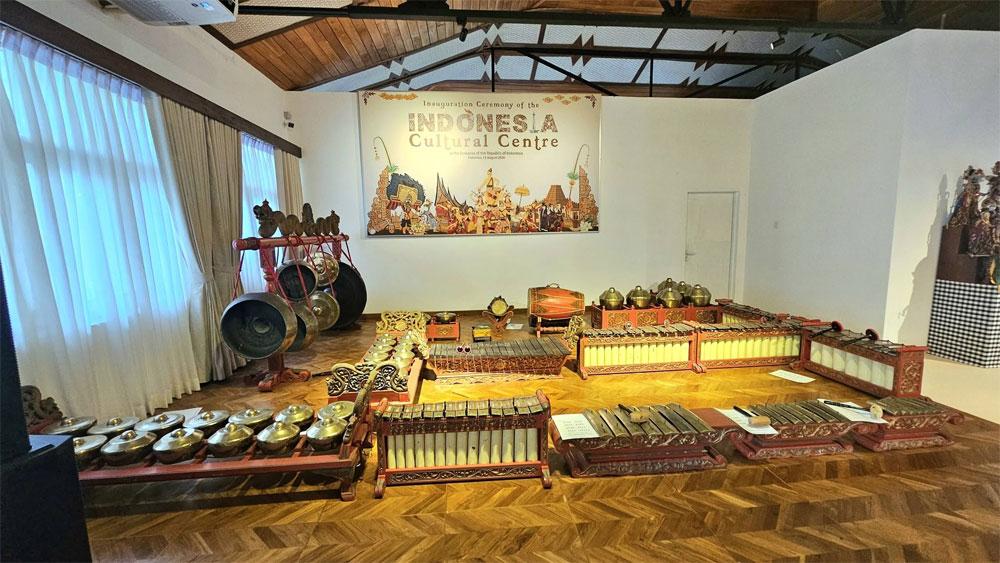
The new centre features a library containing Indonesian books and cultural materials, offering visitors an opportunity to explore the country’s literature, history and artistic heritage. It also houses traditional musical instruments, including the Javanese gamelan and the angklung, alongside Wayang Kulit and Wayang Golek puppets.
The presence of these objects transforms the centre into an educational resource rather than a static display. The gamelan, with its layered metallic tones and carefully coordinated rhythms, represents one of Indonesia’s most recognisable musical traditions, while the angklung demonstrates how a relatively simple bamboo instrument can become part of a richly collaborative performance.
Facilities have also been provided for traditional dance practice, Indonesian language learning and film screenings. These features are expected to make the centre accessible to a wide range of visitors, including schoolchildren, university students, musicians, dancers, researchers and members of the wider Sri Lankan public who wish to learn more about Indonesia.
The Embassy of Indonesia is expected to introduce public classes in Indonesian language, traditional dance and music in the near future. Workshops, art exhibitions, cultural performances and film programmes will also be organised, creating opportunities for regular engagement rather than limiting the centre’s activities to occasional ceremonial events.

The planned programmes could prove especially valuable for younger generations, for whom cultural knowledge is often strengthened through direct participation. A language class can encourage a student to explore Indonesian literature; a dance workshop can lead to a deeper appreciation of movement and storytelling; and a music session can demonstrate how cultural traditions remain living practices rather than distant historical subjects.
Sri Lankan performers celebrate Indonesian traditions
The inauguration ceremony itself provided a vivid illustration of the centre’s intended purpose. A major highlight was the performance by Gamelan Sekar Laras, a Javanese gamelan ensemble comprising Sri Lankan musicians who have received training and mentoring from the Indonesian Embassy in Colombo.
The ensemble performed the popular Javanese composition “Lancaran Gugur Gunung”, bringing the distinctive sounds and rhythms of Javanese traditional music into the centre through the musicianship of Sri Lankan performers. Their participation was particularly significant because it showed that cultural exchange can move beyond observation into genuine learning, practice and artistic ownership.
The cultural programme also featured Tari Tor Tor, a traditional dance associated with the Batak community of North Sumatra. The performance was presented by dancers from the Sanka Samudhi Performing Art Foundation of Kalutara, offering the audience an example of how Indonesian traditions can be interpreted and presented by Sri Lankan artists.
Adding a further dimension to the programme, embassy staff performed Tari Legong Bapang Saba, a traditional Balinese dance distinguished by its graceful movements and expressive gestures. Through the combination of Javanese music, a Sumatran dance tradition and Balinese choreography, the programme presented a concise but compelling portrait of Indonesia’s cultural diversity.
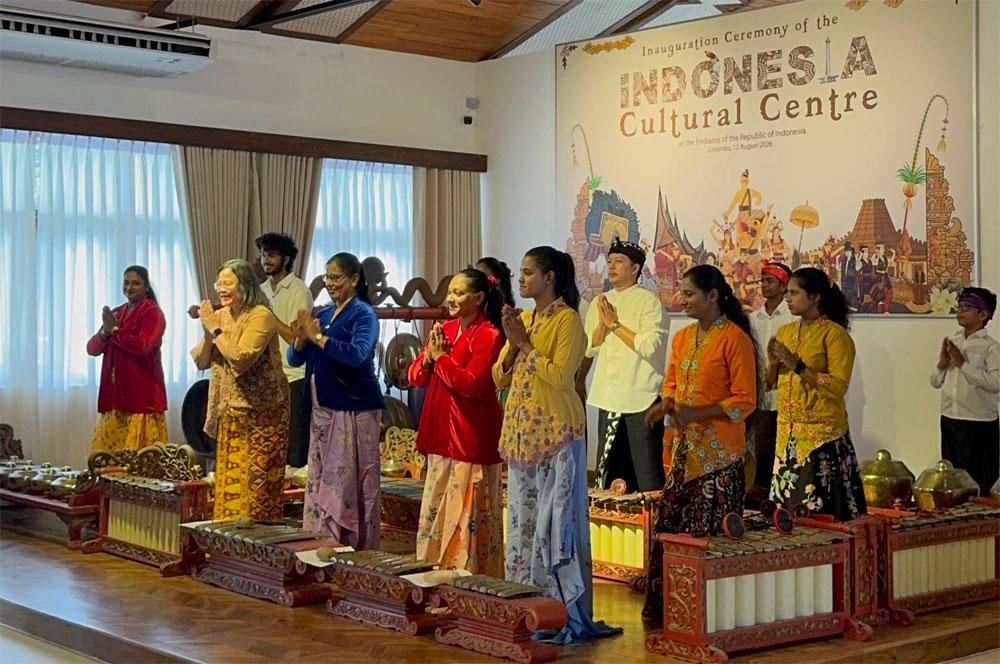
The involvement of Sri Lankan musicians and dancers was also a reminder that cultural friendship is strengthened when audiences are invited to become participants. The performances demonstrated that artistic traditions can cross geographical boundaries without losing their identity, while also gaining new interpretation and fresh energy through local collaboration.
Opportunities for students, artists and communities
Prof. Hiniduma Sunil Senevi welcomed the establishment of the centre as an important expression of Indonesia’s commitment to cultural diplomacy. The Minister highlighted its potential to provide opportunities for young people, students, artists, academics and cultural practitioners to engage with Indonesian heritage.
Such engagement can have benefits extending beyond the arts. Cultural programmes often encourage communication skills, research, creativity and cooperation, while providing students with a more nuanced understanding of a country that might otherwise be encountered only through textbooks or brief media reports.
For artists, the centre could become a useful venue for collaboration, mentoring and presentation. Sri Lankan performers may gain access to Indonesian techniques and traditions, while Indonesian cultural representatives can learn more about Sri Lanka’s own artistic landscape. Universities, schools, museums and cultural institutions may also find opportunities to develop joint programmes and educational initiatives.

The centre’s proposed workshops and exhibitions may further encourage a sustained conversation about heritage, craftsmanship and contemporary creativity. Indonesia’s regional diversity, expressed through its music, dance, textiles, puppetry and film, provides a substantial field for exploration, while Sri Lanka offers its own equally rich traditions in performance, sculpture, ritual, literature and visual art.
A promising new chapter in friendship
The inauguration of the Indonesia Cultural Centre in Colombo arrives as a positive reminder that international relationships are built not only through agreements and official meetings but also through shared experiences. Music rehearsals, language lessons, dance practices, exhibitions and conversations can establish connections that are both personal and lasting.
For Sri Lanka, the centre provides a new window into Indonesian heritage. For Indonesia, it offers a permanent setting in which its cultural traditions can be introduced to Sri Lankan audiences through education and participation. For both countries, it creates a space where friendship can be expressed in practical, accessible and creative forms.
The centre’s future success will depend on the consistency and quality of its programmes, as well as the willingness of schools, universities, artists, community organisations and the public to make use of it. If those partnerships are developed thoughtfully, the Indonesia Cultural Centre could become a significant cultural landmark in Colombo and an enduring symbol of cooperation between Indonesia and Sri Lanka.
Readers interested in Sri Lankan community news, cultural programmes and international connections can follow the latest updates through the eLanka News and Articles page, while organisations seeking to share their services with the global Sri Lankan community can explore the eLanka Business Directory.
Source: https://youtu.be/VsBUOK964c0
This article was written based on the source https://youtu.be/VsBUOK964c0, kindly email us at info@eLanka.com.au if any information needs to be corrected.
At eLanka, we respect the rights of creators. If we have used an image you own and you’d like it removed, please email us at info@elanka.com.au and we’ll handle it promptly.


